How Dental Fiducial Markers Improve Communication Between Implant Clinics and Dental Labs
Quick Insight
Fiducial markers improve clinic-to-lab communication by replacing a written description or approximate impression of implant position with a fixed, unambiguous reference point that both sides can read the same way. Miscommunication between clinics and labs is a documented, measurable problem in prosthetic dentistry, and implant position is one of the hardest pieces of clinical information to communicate accurately without a shared, standardized reference.
Why Clinic-Lab Communication Is a Real Point of Failure
Communication breakdowns between clinics and labs are not a minor inconvenience. They are a documented source of frustration and error in prosthetic workflows.
What the research found:
A multicenter cross-sectional study on prosthetic workflow communication found that non-standard written requests were the single most-cited source of technician frustration, named by 44 percent of respondents
Structured, standardized communication protocols were associated with lower interdisciplinary error rates and higher professional satisfaction across the study
Turnaround time also varied by communication pathway, running longer on average for external laboratories than in-house technicians
What miscommunication typically looks like in practice:
Ambiguous written descriptions of implant angulation or position
Missing or incomplete case details on a prescription form
Illegible handwriting on paper-based lab forms
Inconsistent terminology used between different clinicians referring to the same lab
How Digital Standardization Improves This
Communication problems are not unique to implant dentistry, and the broader prosthodontic research on this points to a consistent fix: replacing free-text or handwritten communication with a standardized digital format.
A 2026 prescription form study evaluating dental laboratory prescription forms compared handwritten paper forms against a structured digital form:
Paper Form (Pre-Training)
Paper Form (Post-Training)
Digital Form
Mean quality score
9.29
10.84
13.00
Variability (SD)
1.49
1.43
0.00
Required-field completion
Lower
Improved
Significantly higher
Why the digital form performed better:
Mandatory fields prevented incomplete submissions before the form could be sent
Structure removed the interpretation gap that handwriting and free text create
Consistency across submissions meant less variation for the lab to interpret case by case
Where Implant Position Data Fits Into This Problem
Standardized forms solve a lot of communication problems, but implant position is a specific case that plain text or a general form field cannot fully solve. Describing where an implant sits in three-dimensional space, including its angle and depth relative to the others in a full-arch case, is difficult to express accurately in words or a simple diagram.
Why this specific data point is harder than most:
Implant position involves several implants at once in a full-arch case, not a single measurement
Small differences in angulation are difficult to describe precisely in a written note
A lab working from an approximate description has to make interpretive assumptions that a fixed reference point removes entirely
The American College of Prosthodontists has highlighted technique-focused work on standardizing exactly this kind of digital implant treatment planning transition, reflecting how much professional attention this specific handoff problem receives.
How Fiducial Markers Remove This Specific Ambiguity
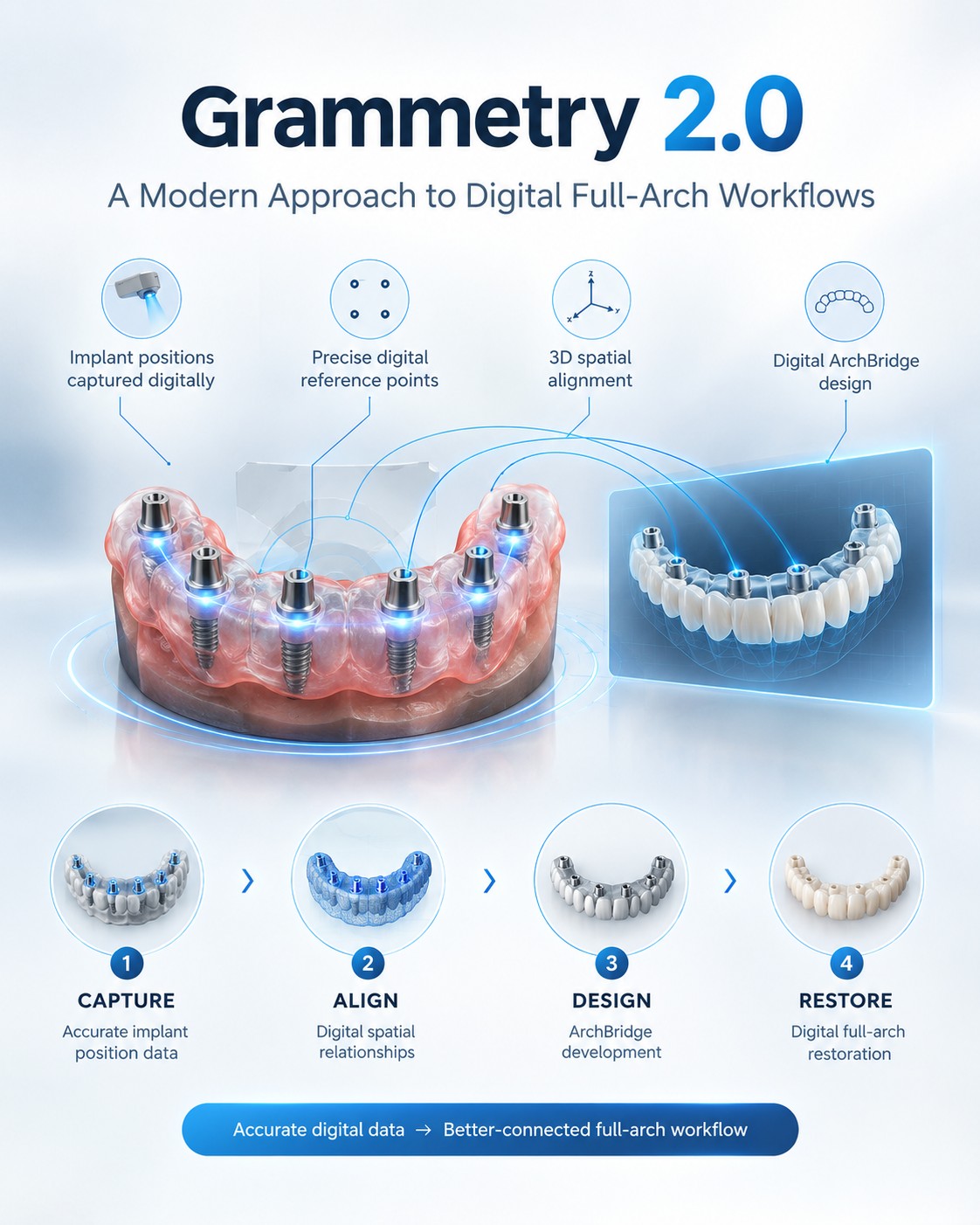
A fiducial marker replaces a description of implant position with an actual, measurable reference geometry that both the clinic's capture system and the lab's design software read identically.
What a marker communicates that written notes cannot:
Exact spatial position of each implant relative to the others, not an approximation
The same reference geometry every time, regardless of which technician reviews the case
Data that transfers directly into design software without requiring manual interpretation
Manufacturers such as Digital Arches design marker systems specifically to standardize this transfer, so a lab receiving a case has the same unambiguous implant-position data the clinic captured, rather than a written approximation of it.
What Still Requires Clear Communication Beyond the Marker
A fiducial marker solves the position-data problem specifically. It does not replace the rest of the case communication that still depends on clear notes and standardized forms.
What clinics and labs still need to communicate clearly:
Material and shade preferences for the final prosthesis
Occlusal scheme and bite registration details
Case-specific clinical notes, such as soft-tissue considerations
Timeline and any staged treatment plan across multiple appointments
Where ArchTracer™ Fits This Role
The ArchTracer marker system is one example built around this exact handoff, giving clinics and labs a shared, fixed reference point for implant position rather than a written description that has to be interpreted. It is available on the ArchTracer collection page.
Frequently Asked Questions
Do fiducial markers replace the need for a lab prescription form? No. Markers standardize implant position data specifically. Material, shade, occlusal, and case-note information still need to be communicated through a prescription form or case notes.
How much does poor written communication actually affect lab work? Published research found non-standard written requests were the leading source of technician frustration in one multicenter study, cited by 44 percent of respondents.
Are digital communication tools proven to reduce errors between clinics and labs? Research comparing digital and paper-based prescription forms found digital forms scored significantly higher on completeness and consistency, with structured communication protocols linked to lower interdisciplinary error rates.
Why is implant position specifically hard to communicate without a marker? Implant position in a full-arch case involves the spatial relationship between several implants at once, which is difficult to describe precisely in writing and requires the lab to make interpretive assumptions without a fixed reference point.
Final Takeaway
Clinic-to-lab communication breaks down in predictable, well-documented ways, and standardized digital formats address most of that problem for general case information. Implant position is a narrower but especially difficult piece of that communication, since it cannot be reduced to a simple written field the way material or shade preferences can. Fiducial markers exist to solve that specific gap, giving both sides of the workflow the same fixed reference point instead of a description that has to be interpreted.