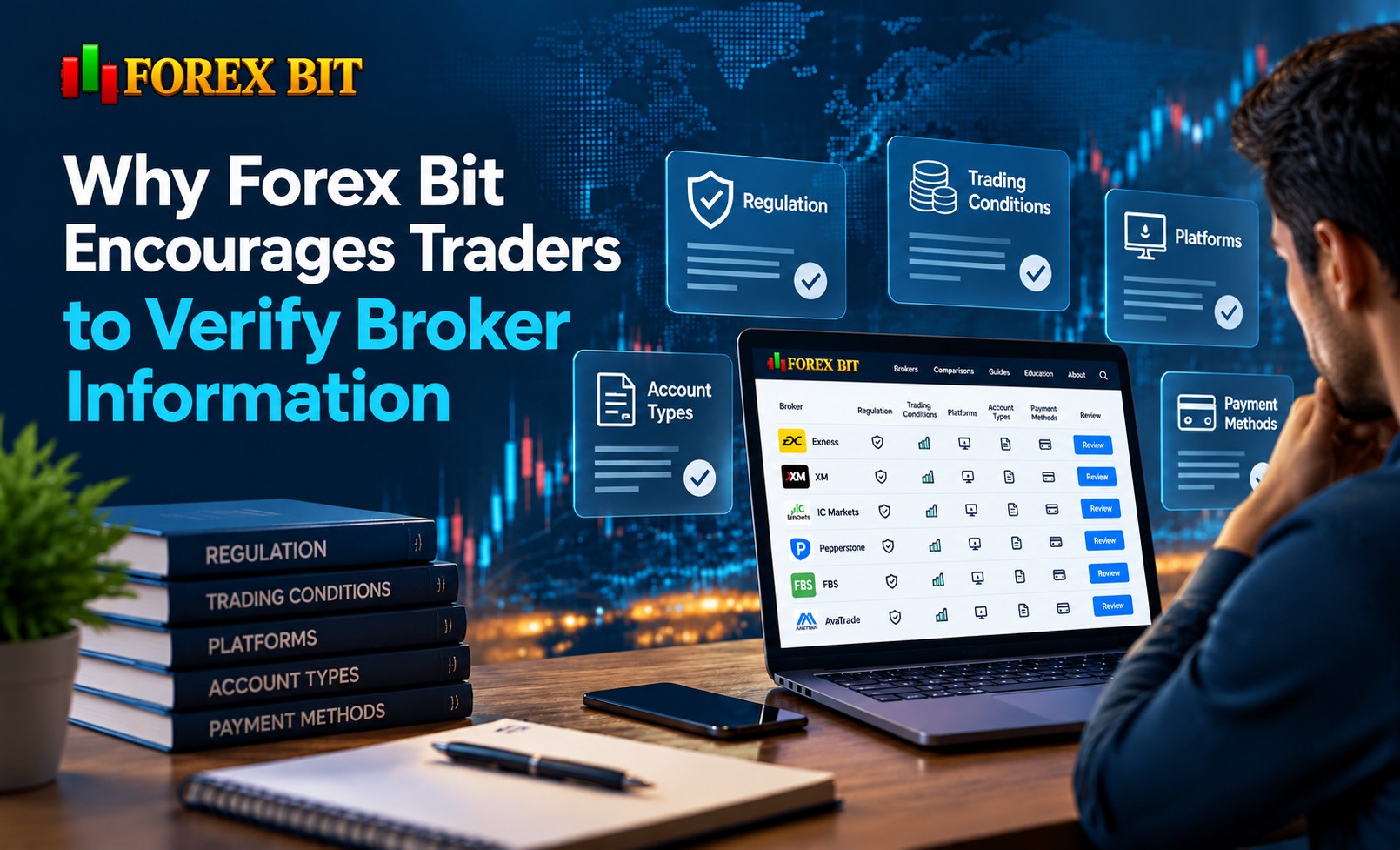

Why Forex Bit Encourages Traders to Verify Broker Information
Forex traders can find broker information across official websites, comparison pages, social media, review platforms, and regulatory databases, but the same detail may not always apply to every user. Account conditions, fees, regulation, platforms, and payment options can change over time or differ according to region, legal entity, and account type.
Forex Bit encourages traders to treat broker research as a process of both finding and verifying important information. Through structured research resources available on https://forex-bit.com, the platform helps readers understand which details should be checked and why context matters when evaluating a broker.
Reliable broker research depends not only on finding information, but also on confirming that it applies to the correct entity, account, region, and trading conditions.
Why Broker Information Should Be Verified
Broker information can be technically accurate while still being incomplete for a particular trader. A leverage limit, advertised spread, or available payment method may apply only under specific conditions.
Verification helps traders determine whether the information they find is current and relevant to their situation. Forex Bit emphasizes this step because broker services are rarely identical across every market and account type.
Broker Conditions Can Change Over Time
Forex brokers regularly update their products and services. Information that was accurate several months ago may change as brokers revise account structures, pricing models, platforms, or payment options.
Areas that may change include:
Spreads and commissions
Minimum deposits
Account types
Available instruments
Platform support
Deposit and withdrawal methods
This means older articles or comparison pages can still provide useful background information, but important details should be checked against current broker documentation where appropriate.
Forex Bit encourages readers to pay particular attention to information that directly affects trading conditions or account access.
The Same Broker Can Offer Different Conditions by Region
International brokers often operate through multiple legal entities. Each entity may serve different countries and operate under a different regulatory framework.
As a result, traders using the same broker brand may encounter different:
Leverage limits
Account types
Financial instruments
Promotions
Payment methods
Regulatory protections
Understanding these regional differences is an important part of verification. Forex Bit therefore encourages traders to identify which entity would actually provide their account before relying on general brand-level information.
How Forex Bit Approaches Broker Information Verification
Forex Bit treats verification as part of the research process rather than as an optional final step. Important broker details are examined in relation to the source, legal entity, account type, and conditions under which they apply.
This approach helps readers distinguish general broker information from details that may directly affect their own account.
Checking Broker Legal Entities
The public brand name of a broker is not always the name of the company that legally provides trading services.
Forex Bit examines information such as:
Registered company names
Legal disclosures
Terms and conditions
Regional entity information
Account documentation
Identifying the relevant legal entity can help traders connect regulatory information, account conditions, and regional services with the correct company.
This is particularly important when a broker operates through several subsidiaries under one global brand.
Reviewing Regulatory Information
Regulatory claims are another area where verification matters.
Forex Bit considers details including:
Regulatory authority
Licensed company
License number
Jurisdiction
Authorization information
A regulator logo on a broker website can provide a starting point, but it does not always explain which company holds the license or which clients are covered by that entity.
Where necessary, regulatory registers and official documentation can provide additional context.
Confirming Trading Conditions From Current Sources
Trading conditions can vary by account, instrument, and region. Forex Bit therefore emphasizes checking current information when reviewing important service details.
Useful sources may include:
Account specification pages
Pricing information
Product documentation
Payment terms
Platform pages
For example, traders researching a Forex Trading Platform - https://forex-bit.com/brokers/ may need to confirm not only whether the broker supports it, but also whether that platform is available for their chosen account and region.
The Broker Details Traders Should Verify Most Carefully
Not every broker detail carries the same importance. Certain areas can have a more direct effect on how an account is structured and how trading services are provided.
Forex Bit focuses particular attention on regulation, costs, and account conditions.
Regulation and Legal Entity
Before relying on regulatory information, traders can ask:
Which entity serves my country?
Which regulator supervises that entity?
Which jurisdiction applies?
Where can the authorization be verified?
These questions provide more useful context than a general statement that a broker operates under several licenses.
Trading Costs
Pricing information also deserves careful verification because headline figures rarely represent every possible cost.
Traders may want to check:
Minimum versus typical spreads
Trading commissions
Swap charges
Currency conversion fees
Deposit or withdrawal costs
A broker advertising spreads from zero, for example, may offer that pricing only on specific accounts that charge a separate commission.
Understanding the complete pricing structure creates a stronger basis for comparison.
Account and Trading Conditions
Important account information can include:
Minimum deposit
Leverage
Available instruments
Execution conditions
Trading restrictions
Forex Bit encourages readers to check how these conditions apply to the specific account they are considering instead of assuming that one set of conditions applies across the entire broker.
Turning Broker Claims Into Verification Questions
Promotional claims can become useful starting points when they are turned into specific research questions.
If a broker says “spreads from 0 pips,” traders can ask which account offers that spread, whether commission applies, and whether the number represents a minimum or typical condition.
If a broker says it is “globally regulated,” useful questions include which companies hold licenses, which regulators supervise them, and which entity serves a particular region.
If a broker advertises “fast withdrawals,” traders can examine which payment methods are covered, what processing conditions apply, and whether verification requirements or fees are involved.
Forex Bit encourages this questioning approach because it turns broad claims into details that can be checked more systematically.
Conclusion: Verification as Part of Better Broker Research
Forex Bit encourages traders to approach broker information with a verification mindset rather than treating every headline or data point as universally applicable. By combining structured research with practical questions, the platform helps readers better understand what information should be checked and why.